Carry real board speed.
If you choke the board before the send, the kite has less forward energy to convert. Stay loose enough to accelerate, then progressively load the edge.
GUIDES · BIG AIR · TAKE-OFF
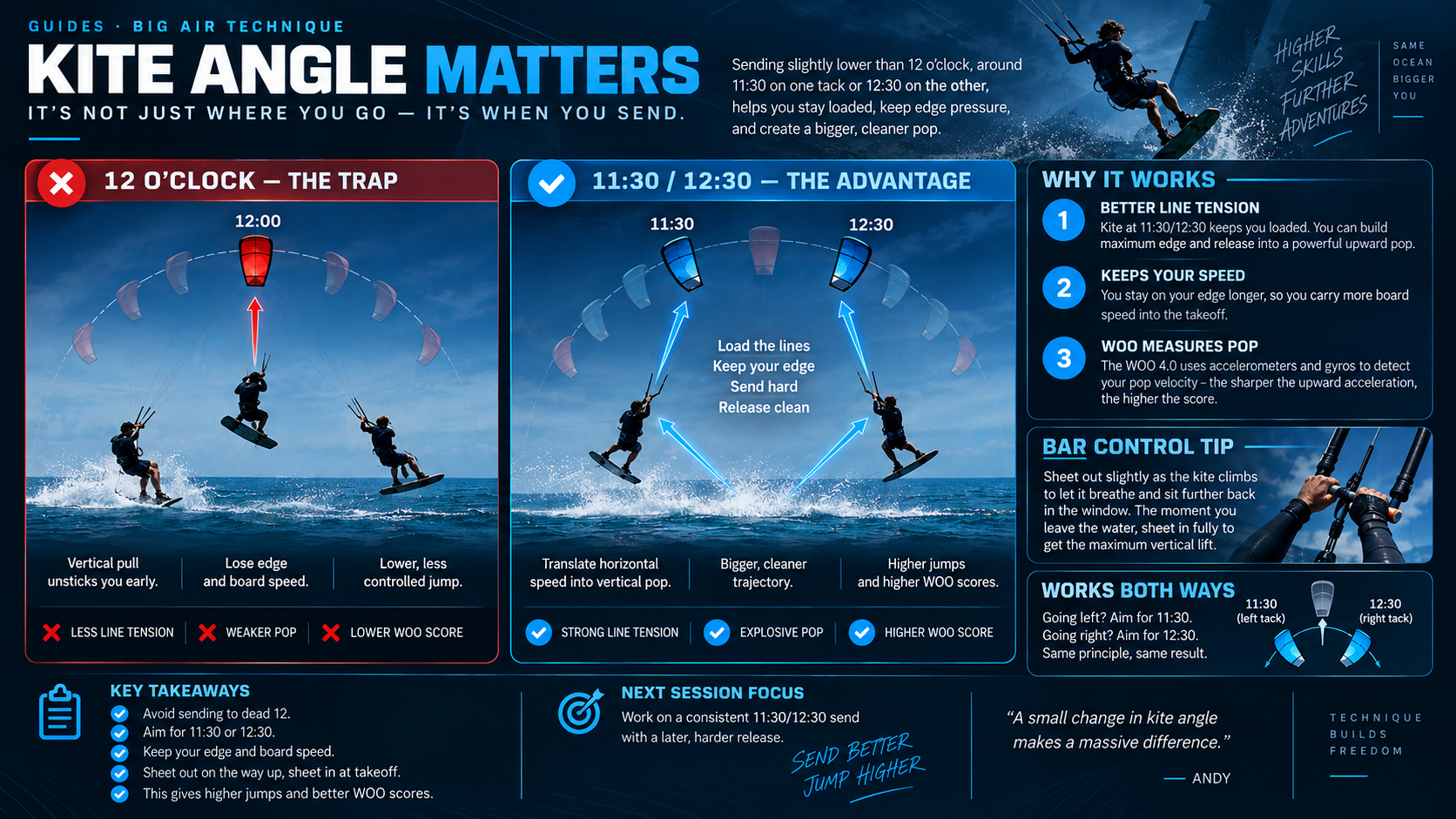
The question is not simply “12 o’clock or 12:30?” It is whether you can keep speed, edge and line tension right up to the release. The best angle is the one that lets you convert the most usable power into a clean vertical pop.
THE COACHING QUESTION
On a big-air take-off, the kite and board have to work together. If you wait too long and the kite is already overhead, you can get lifted off your edge before you have finished loading it. Releasing a little earlier can let you keep more board speed and line tension into the pop.
Your cue: stay fast, load late, send hard, release clean.
WHAT TO FEEL
If you choke the board before the send, the kite has less forward energy to convert. Stay loose enough to accelerate, then progressively load the edge.
You want the kite climbing and the board still resisting. That opposition is what builds line tension. If the edge lets go early, the load leaks away downwind.
The exact clock position depends on tack, kite, wind and send speed. The coaching target is a clean release while you still have tension and usable forward speed.
CLOCK-FACE CUES
A useful “slightly forward of zenith” reference. Test whether you can hold the edge longer and get a sharper release without flattening the board.
Not automatically wrong. On some kites and sends it can work brilliantly. The warning is waiting so long that you lose speed or the kite starts lifting you before you choose to release.
Much further forward. This can create forward drive, but it is not a universal “better boost” target. Treat it as a separate test rather than assuming lower is always higher.
The answer should come from repeated jumps under comparable wind, tack and equipment — ideally with video — then checked against height, airtime, take-off speed and pop metrics.
Keep the kite, board, tack and wind band as consistent as the session allows.
KEEP LEARNING
When the data suggests a release-timing issue, BTE can point you back to this drill instead of giving you a generic “edge harder” instruction.