Start the redirect before you are desperate for it.
If the kite stays parked overhead too long, you drop with little forward drive. Steer it down and forward early enough that it is already pulling you along your intended ride-out line.

GUIDES · BIG AIR · LANDING
A jump is not finished at the peak. Your redirect, board angle and body position decide whether you stomp it, slap down flat, catch an edge or ride away ready for the next send.
THE LANDING CHAIN
The kite needs to move forward before touchdown so you have horizontal drive as well as support. Then set the board slightly downwind, touch down with a back-foot bias, absorb with knees and hips, and progressively level the board as you ride away.
Your cue: redirect early, land slightly downwind, back foot first, absorb, then ride it out.
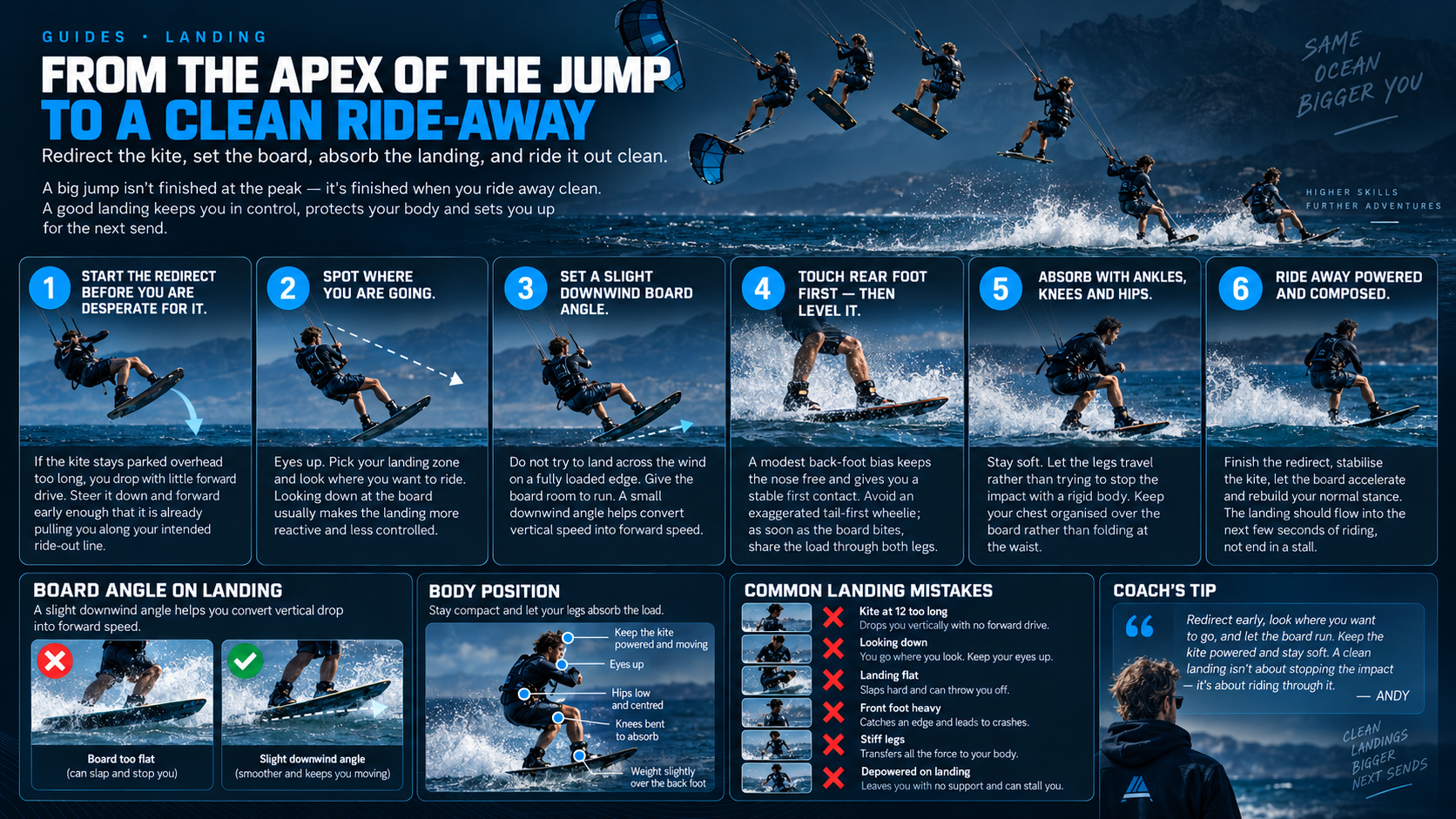
THE SEQUENCE
If the kite stays parked overhead too long, you drop with little forward drive. Steer it down and forward early enough that it is already pulling you along your intended ride-out line.
Eyes up. Pick the patch of water and the direction you want the board to track. Looking down at the board usually makes the landing more reactive and less controlled.
Do not try to land across the wind on a fully loaded edge. Give the board room to run. A small downwind angle helps convert vertical speed into forward speed.
A modest back-foot bias keeps the nose free and gives you a stable first contact. Avoid an exaggerated tail-first wheelie; as soon as the board bites, share the load through both legs.
Stay soft. Let the legs travel rather than trying to stop the impact with a rigid body. Keep your chest organised over the board rather than folding at the waist.
Finish the redirect, stabilise the kite, let the board accelerate and rebuild your normal stance. The landing should flow into the next few seconds of riding, not end in a stall.
BOARD ANGLE
You slap the base, lose speed and take more impact through the body.
The board has somewhere to travel. This is the useful default for a smooth, controlled ride-away.
The rail can catch abruptly and turn a good jump into a hard crash.
WHAT BTE CAN MEASURE
Very smooth impact. Protect the technique that produced it.
Controlled and usable. Look at board angle and ride-away speed before changing anything.
Now the Coach should look at redirect timing, board angle, body position and whether the kite gave you enough forward drive.
Lower landing G is better.BTE keeps landing control separate from boost performance. A high jump does not excuse a poor landing, and a smooth landing should not be treated as a low skill score.
Do five controlled jumps below your maximum height and make the landing the only objective.
COMMON FAILURES
If the kite is still overhead, you have support but little forward drive. Start bringing it forward before touchdown.
Keep the nose from spearing the water and avoid landing too far across the wind.
Give the board a tracking angle and let your legs absorb the vertical load rather than locking against it.
KEEP LEARNING